 The Global Source for Software & Instrumentation
for Ergonomics, Biomechanics & Medicine


HumanCAD® Modules
HumanCAD's plug-in architecture can support a variety of modules from NexGen. The following modules are currently available:
Advanced Feature Set
- Advanced mannequin representation with more realistic degree of freedom and more segments which include detailed spine model (18 versus 3), ulna-radius rotation
- Mannequin with customizable head variable using US Army 1988 and Canadian military database of 1997
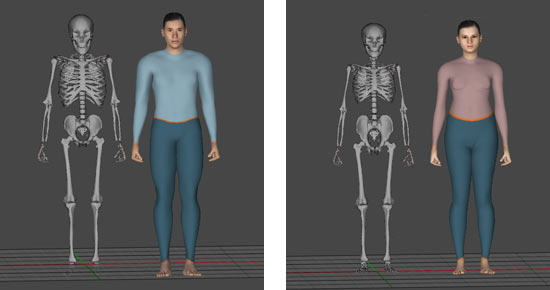
- Mannequin skeleton representation
- More detailed shoulder model
- Collision detection
- Comfort zones
- Additional Discomfort/Comfort analysis
- Enhanced customized anthropometry
- Animation capability which includes collision detection and attached objects support. Animation module provides a choice of interpolation, option to save as a video file and an option to interface with selected ErgoTools (ErgoTools module required).
- Additional anthropometric databases:
- ANSUR I (1989) male and female
- ANSUR II (2012) male and female
- Canadian Army LF (1997) male and female
- CSUM (for CAESAR summary data) for male and female

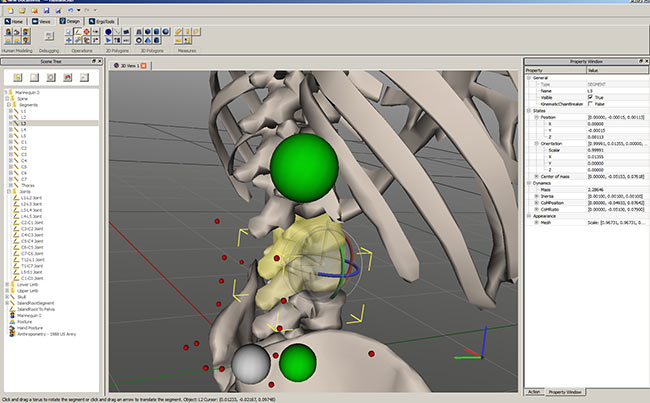
Click thumbnail images to see larger versions.
Skeleton representations of both standard and advanced mannequins
CADExchange
With the optional CADExchange module, HumanCAD customers can import IGES, STEP & STL file formats and export IGES, STEP, STL and DWF file formats. The IGES v5.3 and STEP (AP203 and AP214) formats are supported.
DXF, FBX, OBJ, OSG, OSGB, OSGT, OSGX, IVE, and 3DS file format support come standard with HumanCAD.
ErgoTools
ErgoTools is an optional HumanCAD module that includes:
- Three-dimensional MQ biomechanical model with predictions of the entire body
- Interface with University of Michigan's 3D SSPP model (V7.1.3)
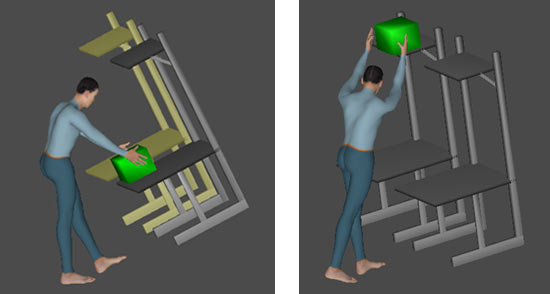
- Revised NIOSH Lifting Equation
- New Liberty Mutual MMH 2021
- Energy Expenditure
- OWAS
- Snook and Mital tables
- Revised Strain Index (RSI), Composite Strain Index (COSI) & Cumulative Strain Index (CUSI)
- AFF method: The AFF (Arm Force Field) method predicts manual arm strength (MAS) for a wide range of body orientations, hand locations and any force direction. This method uses an artificial neural network (ANN) to predict the effects of hand location and force direction on MAS and includes a method to estimate the contribution of the arm's weight to the predicted strength.
- RULA
- REBA
- Hand strength MAE (Maximum Acceptable Efforts) & AFF (Arm Force Field) methods. The MAE method is designed for repetitive tasks that use frequency and/or duty cycle (DC) to predict maximum acceptable efforts (MAE) as a percentage relative to maximum voluntary efforts (MVE). The AFF method predicts manual arm strength (MAS) for a wide range of body orientations, hand locations and any force direction. This method uses an artificial neural network (ANN) to predict the effects of hand location and force direction on MAS and includes a method to estimate the contribution of the arm's weight to the predicted strength.
- Recommended Cumulative Rest Allowance (RCRA) method
- Task Analysis Wizard offers a fast and easy to use way to analyze one or more tasks using several of the ergonomic tools available in HumanCAD. The wizard guides the user in each step of the process and the results of the analyses can be exported into a word processor compatible format.
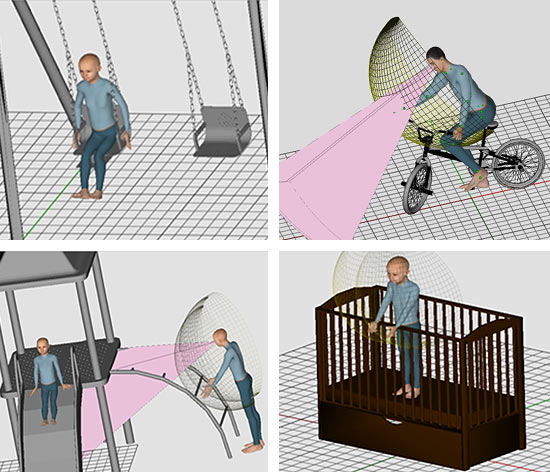
Child Module
Create digital mannequins of children from a variety of age groups from 1 to 19 years of age using various databases. Ranges of Motion (ROMs) are available as well as BSIPs.
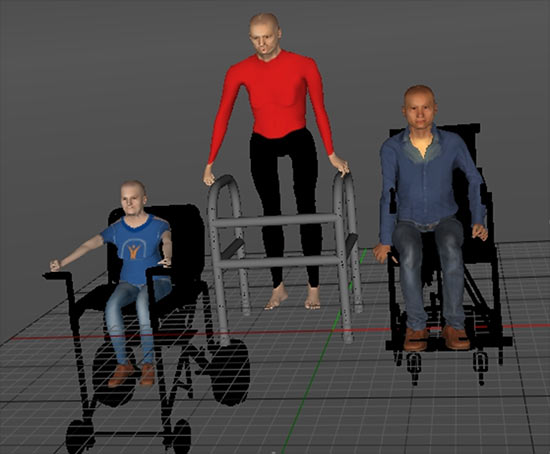
Elderly Module
Digital elderly mannequins can be created from multiple databases and age ranges.
Ranges of Motion (ROMs) are available (for each age group, gender and ethnicity of the added elderly databases) as well as BSIPs databases for elderly populations.
Animation Module
The Animation Module is an optional module of HumanCAD that enables the user to create animation sequences that can be saved and replayed or exported as MPEG-2, WMV or H264 format.
If the optional ErgoTools module is also purchased then biomechanical values may be calculated using either NexGen’s MQ biomechanical model or the 3DSSPP (which is a 3rd party software that HumanCAD interfaces to and is not sold by NexGen).
Features include:
- Multi-core design eliminating the need for baking the animation to play it.
- You can create animations with multiple human mannequins and objects at the same time.
- A simple workflow and interface enables the user to:
- Always render the full human and object instead of a simplified box version
- Always update all the elements to the selected frame states
- If you also purchase the optional ErgoTools module, then they can obtain the posture with the maximum or highest value.